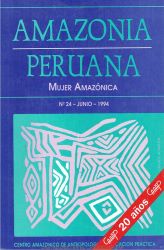
Alta Fecundidade em uma Comunidade Nativa da Amazônia Peruana
DOI:
https://doi.org/10.52980/revistaamazonaperuana.vi24.113Palavras-chave:
Shipibo-Konibo, estudo da fecundidade, aspecto social, aspecto ambiental, aspecto culturalResumo
Trata-se de um estudo inicial da fecundidade e das mudanças culturais em uma comunidade Shipibo, realizado entre 1964 e 1969, que abrange os aspectos social, ambiental, econômico, cultural e sanitário. O crescimento populacional nessa comunidade alcança 5% ao ano, uma taxa superior à encontrada por outros pesquisadores em outros grupos. O estudo analisa os fatores que contribuem para o crescimento populacional e estabelece, entre outras coisas, que a reprodução se inicia em uma idade muito precoce e se prolonga até o final do período reprodutivo. Observa-se que o casamento é universal e que sua alta capacidade reprodutiva se reflete no curto intervalo entre um parto e outro, especialmente devido à diminuição da poliginia, prática desaprovada pelos missionários.
Downloads
Referências
AGUALIMPIA, C. M.; PABÓN, A. R.; CALAN, R. M.; GÓMEZ S., L. C. y GONZÁLEZ, L. E. 1969. «Demographic facts of Colombia». Milbank Memorial Fund Quarterly, 47, pp. 255-296.
BUCK, A. A.; SASAKI, T. T. y ANDERSON, R. I. 1968. Health and Disease in Four Peruvian Villages. Baltimore: Johns Hopkins Press.
COLLVER, O. A. 1965. Birth Rates in Latin America. Berkeley: University of California.
DORJAHN, V. R. 1958. «Fertility, polygyny, and their interrelations in Temne society». American Anthropologist, 60, pp. 838-860.
EARLY, J. D. 1970. «Demographic profile of a Maya community». Milbank Memorial Fund Quarterly, 48(2), pp. 167-178.
EATON, J. W. y MAYER, A. J. 1953. «The social biology of very high fertility among the Hutterites». Human Biology, 25, pp. 206-264.
HERN, W. M. 1976. «Knowledge and use of herbal contraceptives in a Peruvian Amazon village». Human Organization, 35, pp. 9-19.
LATHRAP, D. W. 1968. «The “hunting” economies of the tropical forest zone of South America: An attempt at historical perspective». En: Lee, R. B. y DeVore, I. (eds.), Man the Hunter. Chicago: Aldine, pp. 23-29.
LATHRAP, D. W. 1970. The Upper Amazon. New York: Praeger.
LORIMER, F. 1954. Culture and Human Fertility. París: UNESCO, pp. 58-105; 199-206.
MAXWELL, N. 1970. «Attitudes of four Peruvian jungle tribes towards plants employed as oral contraceptives». Presentado en el 39th International Congress of Americanists, Lima, Perú, 4 de agosto de 1970. (mimeo).
NORTMAN, D. 1969. Population and Family Planning Programs: A Factbook. Reports on Population/Family Planning, N.º 2. New York: Population Council.
SMITH, T. E. 1960. «The Cocos-Keeling Islands: A demographic laboratory». Population Studies, 14, pp. 94-130.
VITAL STATISTICS OF THE UNITED STATES, 1967. 1969. Vol. I: Natality, Section 1, Tables 1-1, 1-2, 1-4, p. 13; Table 1-15, p. 1-15; vol. II: Mortality, Part A, Section 1, Table 1-1, p. 1-1. U.S. Department of Health, Education and Welfare, Washington, D.C.
WEISBARD, S. R. 1957. «Indios Shamas de Perú». Ethnographie, 53, pp. 19-74.
WHITING, J. W. M. 1964. «Effects of climate on certain cultural practices». En: Goodenough, W. M. (ed.), Explorations in Current Anthropology. New York: McGraw-Hill.
Downloads
Publicado
Edição
Seção
Licença
Direitos autorais (c) 1994 
Esta obra está bajo una Creative Commons Attribution 4.0 International License.

Este trabalho está licenciado sob uma licença Creative Commons Attribution 4.0 International License.













 Os artigos publicados estão disponíveis em acesso aberto sob a licença